Adsorption and Ion Exchange
Adsorption on activated carbon is the most widely used method to recover gold from cyanide solutions. Hazen is experienced in the use of carbon adsorption, carbon-in-leach (CIL), and carbon-in-pulp (CIP) in gold circuits. Carbon recovery processes can be evaluated in batch and continuous operations. Hazen’s continuous CIL circuit has been used to design commercial operations.
Activated carbon adsorption has also been used to remove mercury and other metals from solutions and to clean organic impurities from aqueous feed and wastewater streams. Other adsorbants, such as clays, aluminas, and zeolites, have been used for impurity removal.
Ion exchange is widely used in chemical and mining processes for separating one metal from another and for impurity removal. Examples of ion exchange processes developed at Hazen include the recovery of gold and silver from cyanide solutions and alternate lixiviants, and uranium recovery from both acid and carbonate circuits.
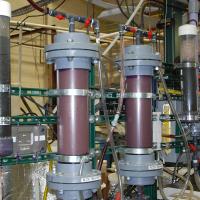
Ion exchange resins are widely used for removing impurities from aqueous process streams, waste water, and mine waters. In waste water and mine water remediation, ion exchange resins can remove the unwanted impurities, concentrating these impurities in a much smaller stream for further processing.
Hazen has generated the design criteria for many commercial operations using both cationic and anionic resins.
Service Applications
Related Capabilities
Contact Hazen
Main (303) 279 4501
Fax (303) 278 1528
E-mail / Directions
Submit RFP