
Facilities & Equipment
Facilities
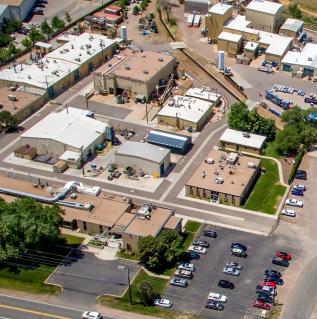
Golden, Colorado, has been home to Hazen since it was founded in 1961. Each of the 18 buildings has specialized equipment that provides flexibility for evaluating different unit and plant operations. Our facilities are equipped to handle hazardous and corrosive materials, radionuclides, and high pressure and high temperature reactions. We have a NEMA Class I Division 2 manufacturing space for large quantities of flammable and combustible materials.
Fabrication Facilities
Hazen also operates a fabrication and machine shop where equipment is designed, configured, repaired, calibrated, or manufactured according to project needs. We maintain an in-house instrumentation and controls department that is integral in designing, installing, and configuring process controls for our project work.
Equipment
Hazen maintains an extensive collection of process equipment for laboratory- and demonstration-scale programs. Our inventory allows us to provide a number of services that cater to the exact needs of our customers. We use state-of-the-art equipment and instruments and remain up to date in a world of rapid growth and change. In addition to our current inventory, Hazen has the capability to make onsite additions that are necessary thanks to our internal fabrication shop.
A partial listing of our equipment follows:
Minerals Beneficiation
- Visit the Gravity Separation page to view an general list of relevant equipment.
Thermal Processing Equipment
Visit the Thermal Processing page or contact us to learn more about the equipment in this list.
- 3 in. Holoflite
- 4 in. Rotary Batch Kiln (quartz)
- 4 in. Fluidized-Bed Reactor
- 5 in. Screw Roaster Kiln
- 6 in. Fluidized-Bed Reactor (various configurations)
- 7 in. Rotary Batch Kiln (quartz)
- 7 in. Holoflite
- 7 in. Continuous Rotary Kiln
- 7 in. High Temperature Furnace (various configurations and materials of construction)
- 8 in. Fluidized-Bed Reactor
- 8 in. Screw Kiln
- 12 in. Fluidized-Bed Reactor
- 15 in. Refractory-Lined Fluidized-Bed Reactor
- 15 in. Direct-Fired Refractory-Lined Rotary Kiln
- 24 in. Refractory-Lined Fluidized-Bed Reactor
- 24 in. Indirectly Heated Rotary Kiln
- 24 in. Top Blown Rotary Converter
- 36 in. Multiple Hearth Furnace
- 60 in. Sectional Kiln
- 63 in. Spray Dryer
- 36 kW Induction Furnace
- Netzsch Simultaneous Thermal Analyzer
- 3 ft3 Harper Box Furnace
- Pug Mill (various materials of construction)
Contact Hazen
Main (303) 279 4501
Fax (303) 278 1528
E-mail / Directions
Submit RFP