
Hazen Research

  • HOME
  • ABOUT
    • MAP & DIRECTIONS
  • VALUES
  • CAPABILITIES
    • ANALYTICAL SERVICES
      • Water, Wastewater
      • Radiochemistry
      • Geologic Materials, Mill Processes
      • Precious Metals, Fire Assaying
      • Coal, Biomass
      • Sample Preparation
      • Quality Control
    • PROCESS MINERALOGY
      • Optical Microscopy
      • Electron Microscopy
      • X-Ray Diffraction Analysis
    • MINERALS BENEFICIATION
      • Gravity Separation
      • Froth Flotation
      • Magnetic Separation
      • Other Beneficiation Methods
    • HYDROMETALLURGY
      • Leaching
        • High Pressure Leaching
      • Solid-Liquid Separation
      • Precipitation
      • Solvent Extraction
      • Adsorption and Ion Exchange
      • Electrochemistry
      • Crystallization
      • Pilot Plants
    • THERMAL PROCESSING
      • Drying, Calcination, Combustion, and Roasting Processes
      • Pyrometallurgy
      • Materials Processing
      • Process Development
      • Waste Treatment and Recycling
      • Analytical Capabilities
      • Equipment
    • ENVIRONMENTAL SERVICES
      • Waste Characterization
      • Hazardous Waste Treatability Studies
      • Quality Assurance and Quality Control
      • Health and Safety
      • Waste Characterization for Remediation Processes
      • Soil Washing Studies
    • ENERGY AND FUEL SERVICES
      • Fuels Characterization
      • Laboratory And Pilot Plant Services
      • Field Services
    • COMMINUTION
    • PILOT PLANT AND OTHER SERVICES
      • Pilot Plants
      • Engineering Services
      • Feasibility Studies
      • Field Services
  • CONTACT
  • JOBS
  • SITE MAP
  • ANALYTICAL SERVICES
  • PROCESS MINERALOGY
    • Optical Microscopy
    • Electron Microscopy
    • X-Ray Diffraction Analysis
  • MINERALS BENEFICIATION
  • HYDROMETALLURGY
  • THERMAL PROCESSING
  • ENVIRONMENTAL SERVICES
  • ENERGY AND FUEL SERVICES
  • COMMINUTION
  • PILOT PLANT AND OTHER SERVICES

HOME : CAPABILITIES : PROCESS MINERALOGY : X-RAY DIFFRACTION ANALYSIS

X-RAY DIFFRACTION ANALYSIS

X-ray diffraction is a means of identifying crystalline compounds. It can be particularly useful when these compounds are very fine-grained components or mixtures.

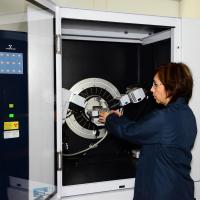
This photograph shows our Philips
X-ray Diffractometer automated with Radix Databox
and Jade MDI software.

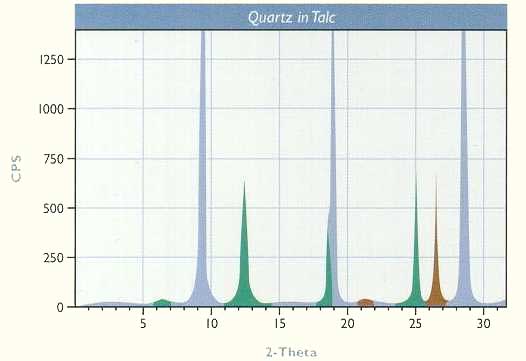
Two problems that were readily solved by x-ray diffraction analysis are discussed below. Talc is a major ingredient in certain cosmetic products. If it contains quartz or other abrasive minerals, it is unsuitable for cosmetic applications. Chemical analysis cannot differentiate between SiO2 present as quartz and SiO2 present as talc. X-ray diffraction analysis is an easy and reliable way to ascertain the presence and quantity of quartz. The peaks in the x-ray pattern below reveal that a minor amount of quartz (brown), along with some chlorite (green), is present in the talc (blue). Through special procedures and with the use of quartz and talc standards, the amount of quartz can be quantitatively determined to levels of less than 1%.
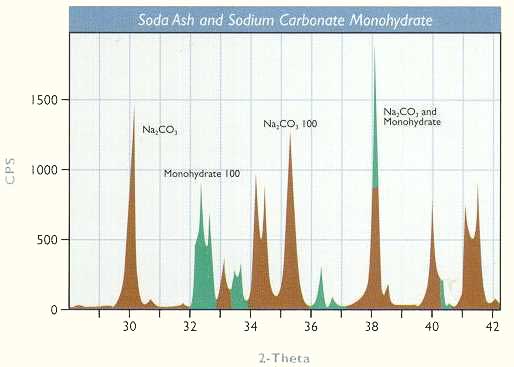
In other industrial mineral applications, health hazards such as respirable silica and asbestos in dust samples or products of commerce can be determined by x-ray diffraction. Crystallization chemistry is a complex science used in the production of compounds ranging from table salt and potash to borax and Epsom salts. Minute changes in the crystallization system can cause significant changes in the product that may not be detectable by chemical analysis or microscopy. One project required that we determine quickly whether the particles forming in a sodium carbonate process were hydrated, anhydrous, or a mixture of the two. The pattern below was obtained by x-ray diffraction analysis and showed the presence of both forms. This permitted us to change the process to generate the desired product.
<< Previous: Electron Microscopy

Client Site Login

Questions or comments about this web site? Send email to webmaster@hazenresearch.com
All other requests should be directed to info@hazenresearch.com
Copyright © 2006 Hazen Research, Inc. All rights reserved.